

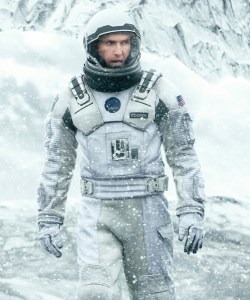
Critical reception for Christopher Nolan’s science fiction blockbuster movie Interstellar was widely mixed. Reviews ranged from being dazzled and awestruck to thinking it utterly ridiculous and silly. Much of the range in opinion had in fact to do with the hard science: hard science that Nolan insisted he get right by hiring theoretical physicist Kip Thorne to best approximate what a black hole and a wormhole will look like and behave. Science so good that it generated a discovery worthy of reporting in a scientific journal (see below). The forums and chats that debated the last half-hour of the movie and its significance were entertaining, if not informative. Interstellar also generated a spate of vitriolic, accusing the film as propaganda for American colonialism (see a few examples below).
I first watched it in an IMAX theatre (the only way to see such an epic–it was filmed using 70mm Imax film, after all), which helped achieve its grandness. Since I was five, I’ve always wanted to be an astronaut. And I’ve always been a sucker for good space adventure–especially well-researched, realistic depictions defined by a good story. And that is exactly what Interstellar is.
I’ll admit openly that this film swept me up like a giant wave. I was humbled and exalted at the same time as it dropped me into some magnificent alien worlds. Deep space; a powerful spherical wormhole; vast shallow waters between mile-high waves of a tidally locked planet; skimming beneath ice-clouds of a barren ice-planet; and falling—literally—into a black hole. All to the recursive echoes of a mesmerizing score by Hans Zimmer. While I was openly moved during the film, its aftertaste caught me unawares and impressed me the most about Nolan’s talent for subtle paradox. I realized that the journey–and deep space–felt inexplicably vast and intimate at the same time.
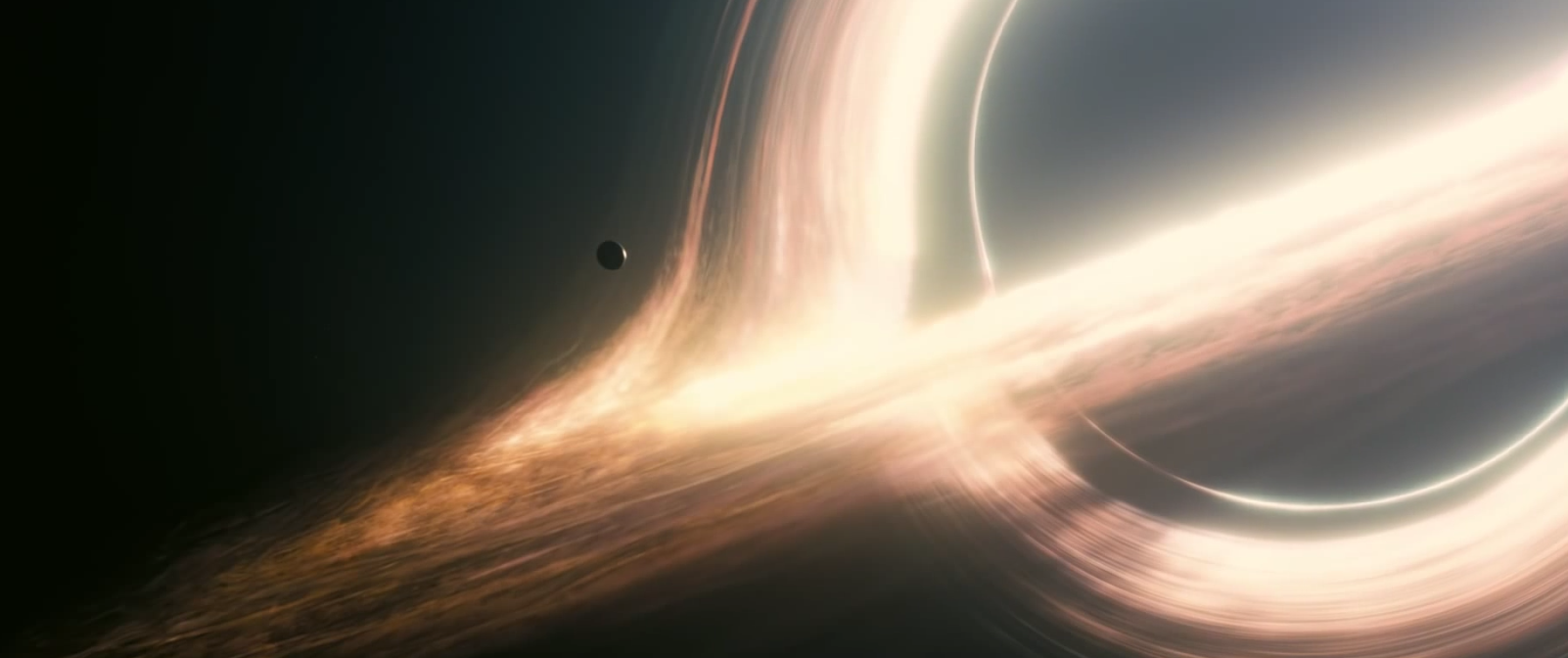
The research by Thorne and Nolan’s visual team generated a scientific discovery. To accurately portray a black hole in the film, Thorne produced a new set of equations to guide the special effects team’s rendering software. Black holes apparently spin at nearly the speed of light, dragging bits of the universe along with it. Based on the notion that it was once a star that collapsed into a singularity, the hole forms a glowing ring that orbits around a spheroidal maelstrom of light, which curves over the top and under the bottom simultaneously. The team then discovered that “warping space around the black hole also warps the accretion disk,” explained Paul Franklin, senior supervisor of Double Negative (the visual experts). “So, rather than looking like Saturn’s rings around a black sphere, the light creates this extraordinary halo.” Thorne confirmed that they had correctly modeled a phenomenon inherent in the math he’d supplied and intends to publish several articles in scientific journals, based on these findings.
Canadian science fiction author Robert J. Sawyer defines good science fiction as: the literature of change; it’s about something “large” (world-important), arises from a scientific premise; and is generally pro-science. Interstellar achieves all of these criteria, particularly the latter.
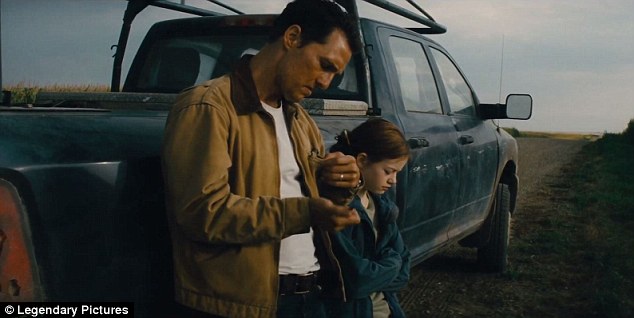
The movie begins in the near-future on a post-climate change Earth, plagued by dust storms and failing crops in a society reverted to parochial superstition. Cooper (Mathew McConaughey), once a NASA pilot and now a farmer, laments: “We used to look up at the sky and wonder at our place in the stars, now we just look down and worry about our place in the dirt.”
In a scene reminiscent of present day schools removing cursive writing from the curriculum or the controversy of teaching evolution (e.g., in favor of creationism), Cooper’s daughter’s teacher, Ms. Kelly, informs him at a parent-teacher meeting that the history textbooks have been rewritten to make known the “truth” about the moon landing: “I believe [the moon landing] was a brilliant piece of propaganda,” attests Ms. Kelly, “that the Soviets bankrupted themselves pouring resources into rockets and other useless machines…And if we don’t want to repeat the excess and wastefulness of the 20th Century, then we need to teach our kids about this planet, not tales of leaving it.”
The danger of turning away from scientific exploration—particularly space exploration—in times of great social and economic insecurity is a theme that runs deep in the film. Not only are scientists and engineers portrayed as whole individuals, both smart and compassionate, but they are also marginalized in a future world looking more to blame than to fix. “We didn’t run out of planes and television sets,” the principal of the school tells Cooper. “We ran out of food.”
When a gravitational anomaly leads Cooper and his daughter Murph (Mackenzie Foy) to a secret NASA base in the middle of nowhere, an old colleague, Professor Brand (Michael Caine), recruits him to pilot the interstellar Endeavor, NASA’s “Noah’s Ark”, into the far reaches of outer space to repopulate the human race. NASA has turned covert due to public pressure against “irrelevant or politically unfeasible” spending. After showing Cooper how their last corn crops will eventually fail like the okra and wheat before them, Brand answers Cooper’s question of, “So, how do you plan on saving the world?” with: “We’re not meant to save the world…We’re meant to leave it.” Cooper rejoins: “I’ve got kids.” To which Brand answers: “Then go save them.”

Unbeknownst to us—and to Cooper, who leaves his precious children behind on Earth for what turns into a one-way mission—the intention is to literally leave the rest of humanity behind. You see, Cooper’s ship—headed toward one of three potentially habitable worlds beyond a wormhole near Saturn—contains the seeds of humanity and other life that the four astronauts aboard are meant to distribute and nurture. Cooper and Brand’s daughter, Amelia (Anne Hathaway), one of the other three astronauts onboard, both believe that the real ark sits back on Earth in the form of a huge spaceship—awaiting Brand’s solution to the gravity issue. Brand knows, but keeps to himself, that the solution is insolvable and sends his intrepid crew off, knowing that Cooper will never see his young son and daughter again.
While Nolan admits to some iconic comparisons with Kubrick’s 2001; A Space Odyssey, Interstellaractually shares much more with the film Contact (in which Kip Thorne and McConoughey also participated). Contact also centered on a ground-breaking scientist daughter who misses her lost father. Mark Kermode, in a Guardian review also saw the relationship:
“In both movies, it is these daughters who detect the first stirrings of an “alien” encounter: Ellie Arroway (Jodie Foster) identifying recurrent sequences in the white noise of interstellar radiation in Contact; Murph (very affectingly played in her younger years by Mackenzie Foy) spying Morse code in poltergeist disturbances in Interstellar. From such discoveries are missions launched, voyaging across time and space at the apparent instruction of a superior intelligence offering cryptic hands across the universe. Intergalactic portals are breached, timescales bifurcated, science and faith reconciled. Crucially, for all their astro-maths exposition, the constant in both stories is neither time, space, nor gravity, but love. More than once I was reminded of Contact’s Ellie striking the outer limits of the universe and breathlessly declaring: ‘They should have sent a poet.’”
Interstellar’s American-centric presentation generated some criticism (e.g.,
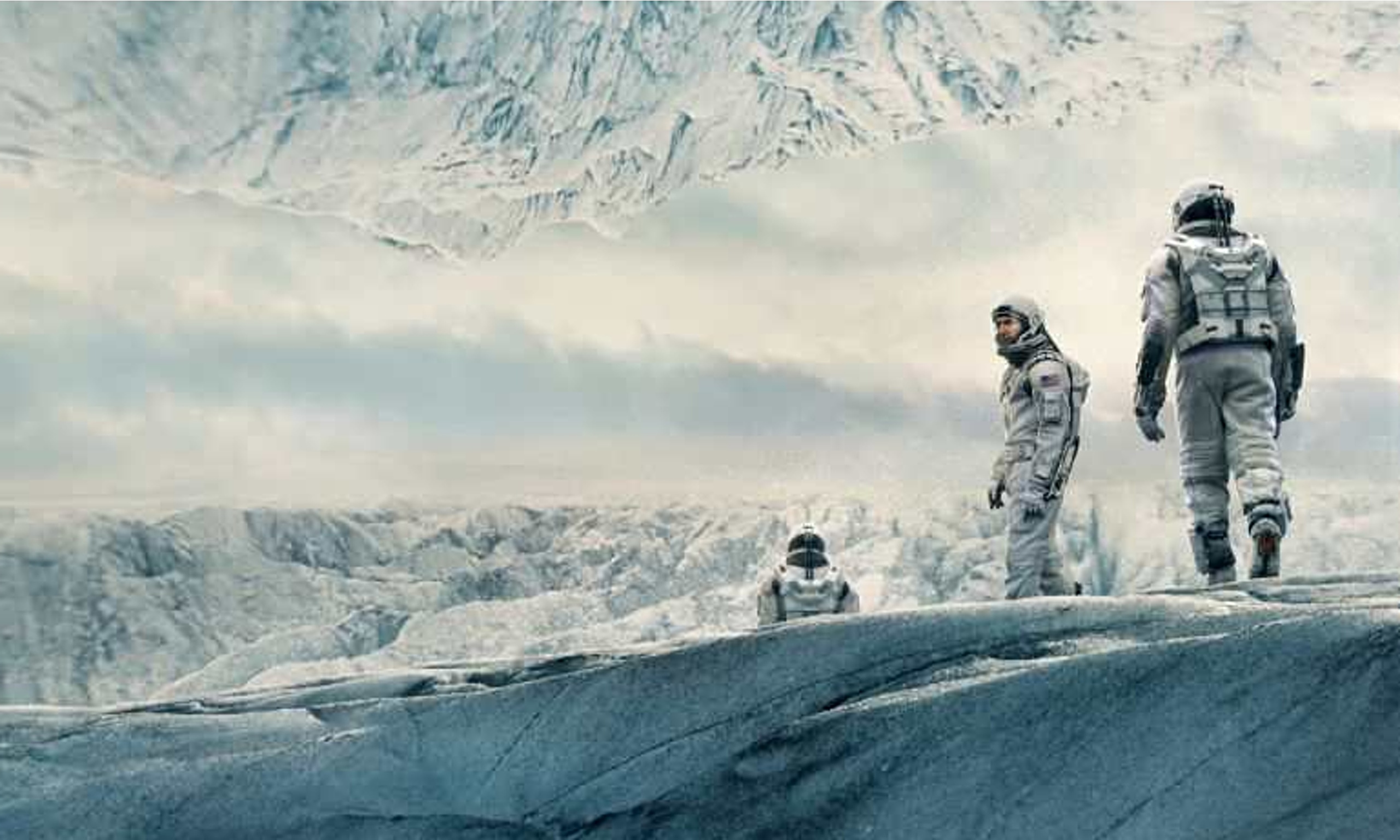
NASA acting alone without any international help; all American actors; American flags erected on settled colonies). Some even vilified the film as “a dangerous fantasy of US colonialism”. Journalist Abraham Riesman raises valid issues to do with human-centric expansionism in Interstellar:
“Coop and his coterie make one assumption that the movie never questions: Humanity (which, for all we ever see, is white, English-speaking America with a couple of black friends and one British guy) deserves to go to the stars and will suffocate if it’s confined to its current environs. That logic was, of course, one of the main justifications for most imperial expansions since the dawn of the 1800s. No one stops to ask whether this civilization (which, in the movie, appears to have murdered its home planet through human-caused climate change, though, for some reason nobody talks about that) needs to make some fundamental changes in its approach to social construction and resource use. Indeed, when we see the bright new future on Cooper Station, it’s all baseball and manicured lawns. Perhaps more important, no one questions whether human expansion will kill off the new planets’ current residents. Sure, we’re told that the planets are uninhabited … but uninhabited by what? Carbon-based humanoid lifeforms? What if we immediately kill off whatever fragile ecosystems we find once we take off our helmets and exhale our Earthly germs? Of course, I’m reading too much into a movie that isn’t even implying any of the messages I’m inferring, but that’s the problem right there: No one’s even asking the questions, and for humans, that kind of attitude usually leads to bad answers.”
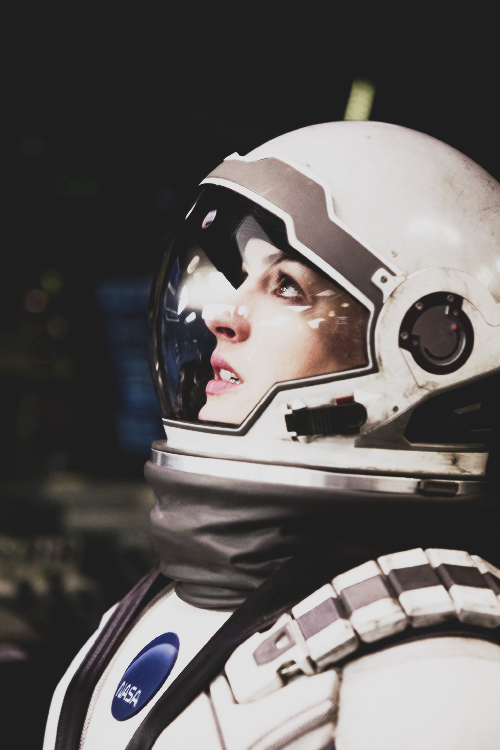
What saves Interstellar from skidding into 20th Century pseudo-jingoistic expansionism with undertones of patriarchal rationalism, is its subversive theme. And because of it, the movie transcends into artistic commentary.
I speak of love. Love embodied by two of the main characters—both women: Cooper’s daughter, Murph, and his shipmate, Amelia Brand. Love that is irrational. Love that is unscientific. Love that is inexplicable. And love that is all powerful. Inviolate. Eternal. And, I believe, our salvation.
Aspects of “imperialist expansionism” and “patriarchal rationalism” interplay through Cooper, who embodies both in his “cowboy” science. Love propels his evolution to transcend them. In Cooper, we see the constant tension between rationality of science and the “irrational” faith of love. Related to this, Cooper must continually choose between the personal and the whole in defining his humanity and ultimately his hard choices. First with his daughter and her “ghost”, then with Amelia Brand in their mission to another galaxy.
After a botched mission, Amelia appears to abandon the very tenets of hard science to ask the defining question: “Maybe we’ve spent too long trying to figure all this out with theory. Love is the one thing that transcends time and space.” She describes love as a cosmic force, a kind of empathic drive that provides the very basis for humanity’s survival: a link to our wholeness as living beings within a breathing multi-dimensional universe. When Cooper challenges Amelia’s unscientific notions, she responds with, “Love isn’t something we invented. It’s observable, powerful … Maybe it’s evidence, some artifact of higher dimensions that we can’t consciously perceive.” Amelia nails it when she, in turn, challenges Cooper: if the second choice turns out bad, they will have enough fuel to do only one of two things: go on to the third planet in hopes of distributing the seeds of humanity OR go back home to his children. Which will he choose? It’s interesting what he does end up choosing: he chooses love. Love drives him to do impossible feats, like dock his shuttle with a damaged and recklessly spinning Endeavor:
CASE: That’s impossible
COOPER: No, it’s necessary
Love for Murph drives Cooper into the black hole … and out of it. Love directs him to that precise quantum moment where his love for Murph transcends into love for all humanity: to save the world. This is the secret. The secret Mann in his intellectualized definition of what it means to be human could not touch. The window for connection to the whole is through a single tiny grasp of it. The glimpse into Eternity is through the lens of love. I am reminded of a quote in David Mitchell’s Cloud Atlas: “What is any ocean but a multitude of drops?” In Spielberg’s Schindler’s List, Itzhak Stern quotes the Talmud: “Whoever saves one life, saves the world entire.”
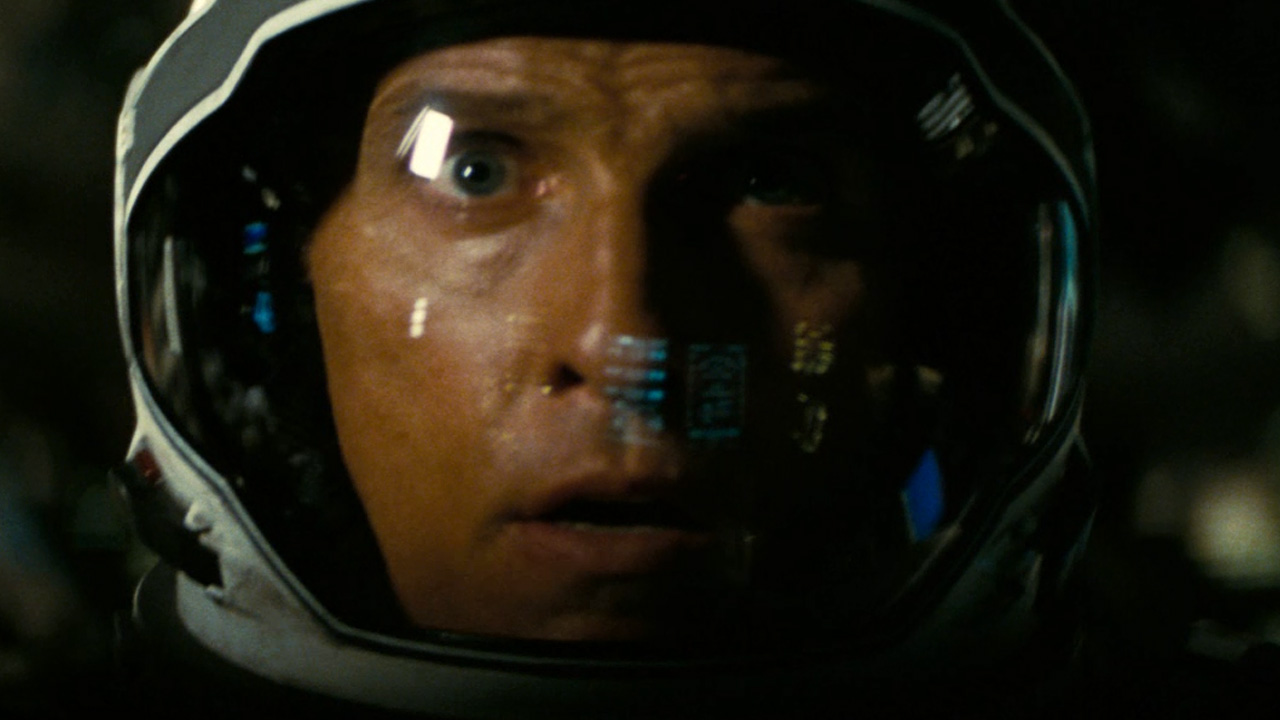
So what is love, then? Is it gravity? Does it communicate through the God particle in the fractal fabric of the Higgs field? What other phenomenon grows from nothing? What other phenomenon is not lessened but in fact grows by giving it away? What other phenomenon provides the very weight and structure (the meaning) of our existence? What other phenomenon is like a whisper in a crowded room, yet creates the most beautiful symphony? Is it that simple?
If gravity is a plane of existence, a fifth dimension that can exist across space-time, is a black hole simply a doorway? Like death? Is love the fuel of evolution, lifting us up into a higher state?
Catholic theologian Peter Kreeft shares: “…Gravity is love on a material level. In fact, [gravity] has two movements: one is towards union, back to the center, the big bang, the past by gravity. And the other is to give itself out to all other beings, out into the future, the expanding universe, by energy and by entropy, which is energy giving itself out to the empty places.”
What struck me the most about Interstellar was how it simultaneously evoked my breathless awe in the vast universe’s existentialist grandeur with a personal connection and intimacy. Interstellar was soul-nourishing, dream-engaging; and its recursive themes called of “home”.
Definitions:
Wormhole: Officially known as an Einstein-Rosen Bridge, a wormhole is a hypothetical topological feature of spacetime that would fundamentally be a shortcut through spacetime.
God Particle: Also known as the Higgs boson or Higgs particle, the God particle is believed to be the subatomic particle that gives everything mass. Without it, nothing would have weight or even structure. The Higg boson is an elementary particle with no spin, electric charge or colour charge. It is considered the smallest possible quantum excitation of the Higgs field that unlike the more familiar electromagnetic field cannot be “turned off”; instead it takes a non-zero constant value almost everywhere.
Higgs Field: In two papers published in 1964, Peter Higgs posited that particles obtain mass by interacting with a mysterious invisible energy force field that permeates the universe: the Higgs field. It is the stuff of stars, planets, trees, buildings and animals. Without mass, electrons, protons and neutrons wouldn’t stick together to make atoms; atoms wouldn’t make molecules and molecules wouldn’t make us. The presence of the Higgs field explains why some fundamental particles have mass while the symmetries (laws of nature) controlling their interactions should require them to be massless, and why the weak force has a much shorter range than the electromagnetic force.
 Nina Munteanu is a Canadian ecologist and novelist. In addition to eight published novels, she has authored award-winning short stories, articles and non-fiction books, which were translated into several languages throughout the world. Recognition for her work includes the Midwest Book Review Reader’s Choice Award, finalist for Foreword Magazine’s Book of the Year Award, the SLF Fountain Award, and The Delta Optimist Reviewers Choice.
Nina regularly publishes reviews and essays in magazines such as The New York Review of Science Fiction. Strange Horizons, IROSF, Europa SF and others. She serves as staff writer for several online and print magazines. She teaches and coaches writing online through her website Nina Munteanu. Her books on writing “The Fiction Writer: Get Published, Write Now!” and “The Journal Writer” were translated into Romanian and published by Editura Paralela 45. Her latest book, The Way of Water / La natura dell’acqua is a post-climate change story and essay published by Mincione Edizioni (Rome).

 Canadian science fiction thriller Orphan Black, written by Graeme Manson and directed by John Fawcett—now in Season Two—stars the extraordinary multi-talented Tatiana Maslany in multiple roles of herself—really.

 Issues, brought on by GMO foods and medical genetic research, have propelled a major debate in gene patenting. The United States Supreme Court recently ruled against patenting sequences of the human genome in Association for Molecular Pathology Et Al. vs. Myriad Genetics, Inc., Et Al., reports Isabella Kapur in her article: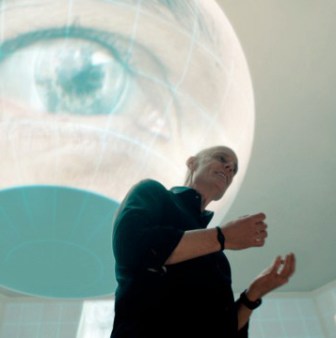
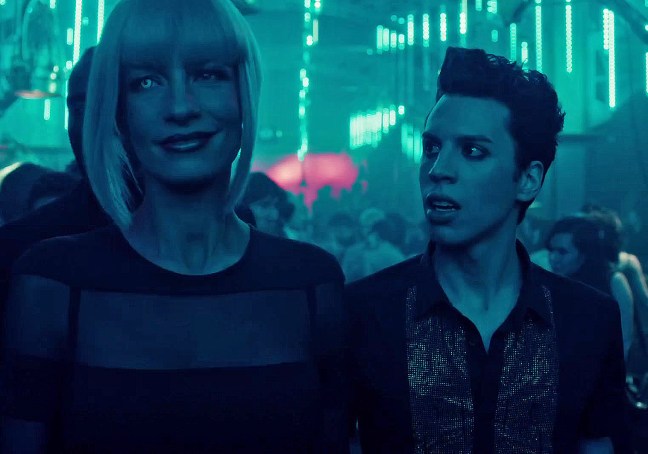
 The Dyad Institute, a biotech corporation with arcane connections to invisible powers and eugenics, patented the clones as theirs to do with as they please—which might be anything. The Neolutionists, a transhumanist movement pursuing “self-directed evolution” evokes social Darwinism and the Übermensch. All bring to mind the early American eugenics programs that inspired the fascist sonderweg and Hitler’s aggressive application of eugenics in the Holocaust. All are frightening.
 Where do we draw the line in our tightrope walk across the sea of chaos to find the Holy Grail? When does a Transhumanist’s individual expression of “transcendence” become a movement toward the Singularity? When does a singular powerful thought encompass an entire society?


 From its metaphoric title to its powerful end, Director Michael Bay’s The Island had me fully engaged. Told in the genuine style of great science fiction commentary by screenwriters Caspian Tredwell-Owen, Alex Kurtzman and Roberto Orci (in 2005), The Island reflects the escape-from dystopia films of the 1960s and 70s such as Fahrenheit 451, THX 1138, and Logan’s Run. This elegant story examines a full range of human foibles—consumerist greed, racism, fascism and isolationism—through a premise that is as frightening as it is possible.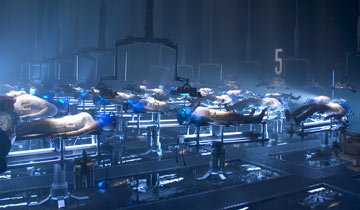
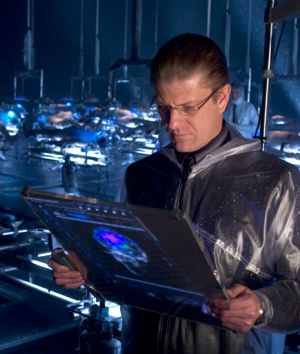
 with a 40% “Rotten” rating, based on 185 reviews. Variety’s Justin Chang called the film an “exercise in sensory overkill.” Salon’s Stephanie Zacharek lamented that when the film got really interesting, Bay seemed to think he needed “to throw in a car crash or round of gunfire to keep our attention.” If these critics found fault with this elegant action-thriller, I hate to see what they make of 90% of the so-called SF movies out there today. Unlike them, The Island provides a refreshing meaningful face to action-adventure.
 I was particularly struck by the timing of the strings and chorus with the appearance of Albert Laurent, walking among those he had just liberated. It is a pivotal and powerful moment that escalates into a resonating vibration of liberty and victory as his eyes meet briefly with Lincoln and Jordan, reunited, and he smiles—for the first time. A beautiful smile of inner joy. It is the smile of a man who has “come home” and is finally free.
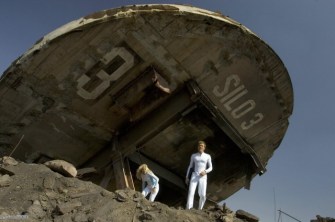 This motion picture is ultimately about finding dignity in the face of adversity and ridicule. It is about confronting the bully and gaining victory over one’s own barriers of fear and doubt toward compassion. It is about the power of love and connection with humanity. It is about retribution and finding one’s true path through the knowledge that we are all one.
 Nina Munteanu is an ecologist and internationally published author of award-nominated speculative novels, short stories and non-fiction. She is co-editor of Europa SF and currently teaches writing courses at George Brown College and the University of Toronto. Visit
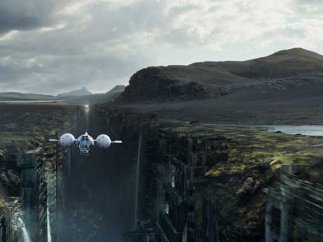 I just recently experienced the visually stunning motion pictureOblivion in an IMAX theatre and I highly recommend it. Directed by Joseph Kosinski (based on his graphic novel), this SF action thriller is worth seeing on the big screen. It takes place in a devastated NYC (no longer recognizable as a vast lonely landscape of buried skyscrapers and dried up rivers). It’s 2077, sixty years after aliens invaded and destroyed the moon and much of the planet as consequence. This film is LARGE. Kosinki’s spectacular imagery and M83’s other-wordly and evocative score must be seen large.


 Oblivion is not a “pretty movie” and certainly not served cold. Vast. Beautiful. Eerie. Elegant. Visceral. Memorable. I also saw many similarities with the various films Dizon and others mentioned (I would include Bladerunner and Solaris in the mix). But here’s the thing: science fiction is the literature of “the large”. SF metaphorically explores our evolution, the meaning of our existence and our place in the universe through premise and idea. It is not surprising that viewers will see similarities with other films in Kosinski’s meditation on the nature of the soul, identity, self-actualization, love and community.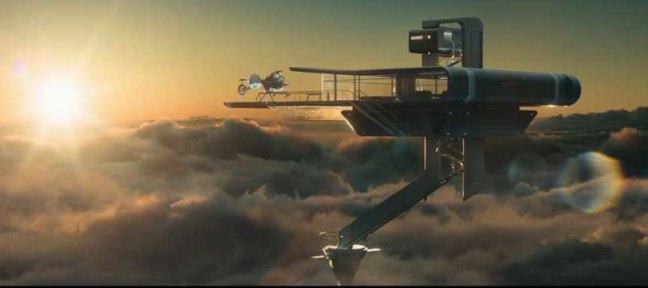

 I reread Dr. Isaac Asimov’s 50+ year old masterpiece, I, Robot, in preparation for the 2004 Twentieth Century Fox motion picture of the same name, knowing fully well that to appeal to today’s action-thriller rollercoaster-addicted audience there was no way the movie and the book could even come close. I was right. But not the way, I thought I would be.


 Nina Munteanu is a Canadian ecologist and novelist. In addition to eight published novels, she has authored award-winning short stories, articles and non-fiction books, which were translated into several languages throughout the world. Recognition for her work includes the Midwest Book Review Reader’s Choice Award, finalist for Foreword Magazine’s Book of the Year Award, the SLF Fountain Award, and The Delta Optimist Reviewers Choice.
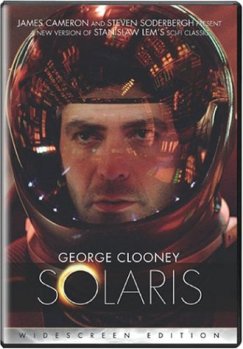 Steven Soderbergh’s stylish psychological thriller, released November 2002 in the United States by 20th Century Fox (and recently out on video), eloquently captures the theme of Stanislaw Lem’s 1961 book. Written almost fifty years ago, Solaris is an intelligent, introspective drama of great depth and imagination that meditates on man’s place in the universe and the mystery of God. Soderbergh’s Solaris is a poem to Lem’s prose. Both explore the universe around us and the universe within. Not particularly palatable to North America’s multiplex crowd, eager for easily accessed answers, Solaris will appeal more to those with a more esoteric appreciation for art.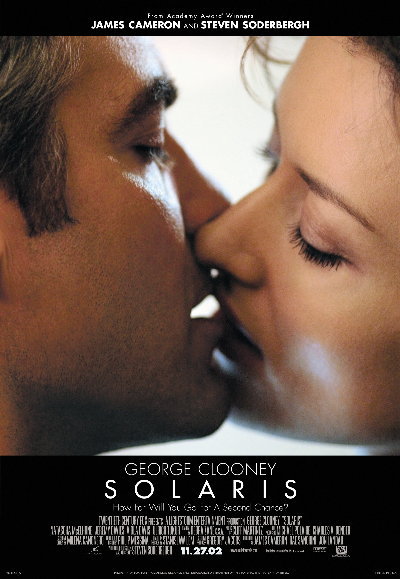

 Nina Munteanu is a Canadian ecologist and novelist. In addition to eight published novels, she has authored award-winning short stories, articles and non-fiction books, which were translated into several languages throughout the world. Recognition for her work includes the Midwest Book Review Reader’s Choice Award, finalist for Foreword Magazine’s Book of the Year Award, the SLF Fountain Award, and The Delta Optimist Reviewers Choice.
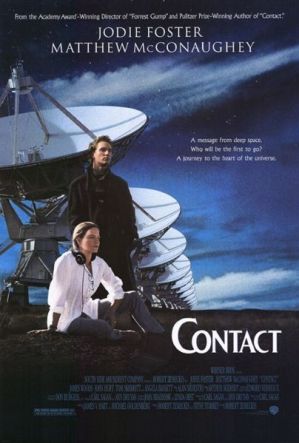 The opening sequence tells the entire story… It is both spectacular and humbling at the same time as we begin with a view of Earth gleaming in a sunrise. An almost frantic jumble of broadcasts— news, TV shows, music—assail our ears. As we pull back from Earth and pass the outer planets, we hear older broadcasts… disco…Kennedy… the Beatles… Hitler…then ultimately the unintelligible static of all the radio stations on Earth. Then, as we leave the solar system, passing breathtaking nebulae, the sounds give way to silence. A dead silence, as we continue to pull back out of the galaxy and out of the local group of galaxies into the quiet depth of our vast universe. “It’s enough to make you feel tiny and insignificant and alone,” says Maryann Johanson of FlickFilosopher.com. “Which is precisely the feeling it’s meant to evoke.” From that arcane vastness, we are brought back to our own “intimate” existence within it as the universe transforms into a dark reflection in a young girl’s eye.


 Nina Munteanu is a Canadian ecologist and novelist. In addition to eight published novels, she has authored award-winning short stories, articles and non-fiction books, which were translated into several languages throughout the world. Recognition for her work includes the Midwest Book Review Reader’s Choice Award, finalist for Foreword Magazine’s Book of the Year Award, the SLF Fountain Award, and The Delta Optimist Reviewers Choice.
 sfgirl Reviews...